Address
304 North Cardinal
St. Dorchester Center, MA 02124
Work Hours
Monday to Friday: 7AM - 7PM
Weekend: 10AM - 5PM
Address
304 North Cardinal
St. Dorchester Center, MA 02124
Work Hours
Monday to Friday: 7AM - 7PM
Weekend: 10AM - 5PM

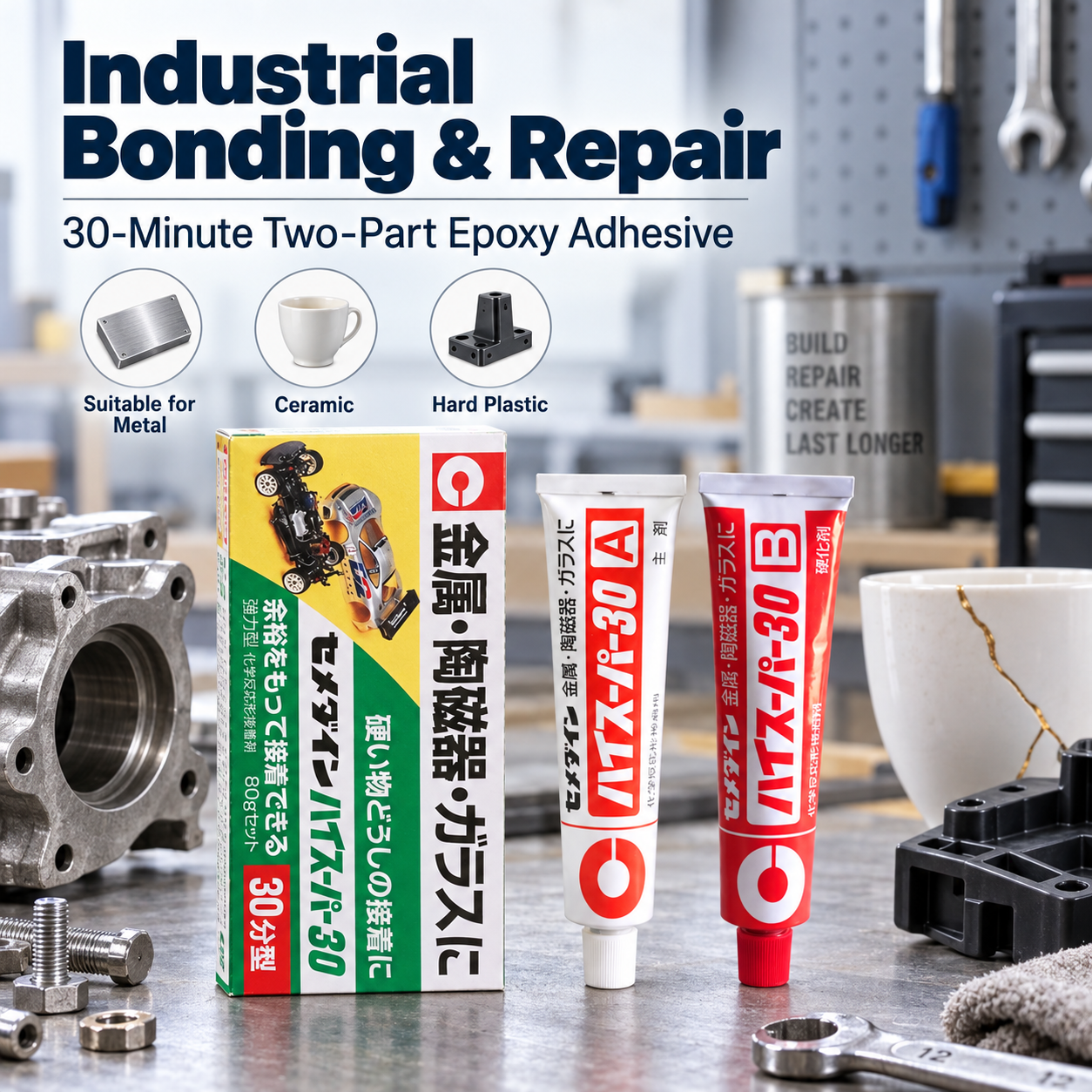
CEMEDINE High Super 30 is a reactive epoxy adhesive that cures through the chemical reaction between its resin and hardener rather than through solvent evaporation. This solvent-free mechanism minimizes curing shrinkage and helps the material fill small gaps and surface irregularities between compatible rigid materials. It provides strong adhesion, electrical insulation, and good durability, while its extended working time supports careful positioning of larger or more complicated parts.
Official CEMEDINE technical information lists a 1:1 resin-to-hardener mixing ratio by volume, a usable time of up to 30 minutes at 23°C, and practical strength after approximately one hour. The standard curing condition is 24 hours at 23°C. The resin has a typical viscosity of approximately 70 Pa·s and density of 1.17 g/cm³, while the hardener has a typical viscosity of approximately 160 Pa·s and density of 1.14 g/cm³.
The relatively thick consistency allows the mixed epoxy to be spread with the included spatula across flat, curved, and slightly uneven surfaces. It is especially useful when accurate alignment is more important than extremely fast fixture time. The mixed adhesive begins hardening after approximately 30 minutes, giving operators enough time to prepare, position, adjust, and secure many repair or assembly projects.
CEMEDINE CA-193 30-Minute Epoxy Adhesive is recommended for joining hard materials such as metal, pottery, ceramic, and selected rigid plastics. Typical uses include repairing metal models, assembling plastic models, bonding ceramic ornaments, restoring fishing tackle, attaching decorative hardware, repairing tool parts, and completing DIY projects where precise positioning is required.
The adhesive is also suitable for handicraft workshops, model-making classes, maintenance departments, hardware repair, hobby production, and small-volume assembly. Its resistance to heat, water, and chemicals makes it more durable than many ordinary craft adhesives when the bonded components may experience moisture, temperature changes, cleaning agents, or normal service wear.
The product is not recommended for polyethylene, polypropylene, nylon, soft PVC, fluoropolymer, or rubber. Large glass bonding areas should also be avoided because curing shrinkage may produce internal stress and increase the risk of glass cracking. It should not be used on precious objects, high-value items, food-contact areas, skin-contact surfaces, living-animal containers, or extremely small joints that cannot provide sufficient bonding area.
Remove dust, rust, oil, grease, water, old adhesive, and loose contamination from both bonding surfaces. Dry the materials completely before application. Light abrasion may improve bonding on suitable smooth metal or rigid plastic surfaces, but all sanding residue must be removed before the epoxy is applied.
Dispense equal volumes of Part A resin and Part B hardener onto the supplied mixing plate. Blend both components thoroughly with the spatula until the original pink color disappears and the mixture becomes uniform. Scrape the sides and bottom of the mixing area during blending to prevent unmixed material from entering the joint.
Apply the mixed adhesive immediately and spread it evenly across the bonding surface. Join the components while the material remains workable, then secure the assembly with tape, cord, a clamp, or another suitable fixture. Apply enough pressure to create complete contact, but avoid excessive force that could squeeze all adhesive from the joint.
Keep the components motionless while initial strength develops. Practical strength may be reached after approximately one hour at 23°C, but the assembly should be allowed to cure for approximately 24 hours before demanding use. Lower temperatures generally slow the reaction, while higher temperatures or larger mixed quantities may shorten the available working time.
Under the manufacturer’s reference test conditions, the cured adhesive provides tensile-shear strength of approximately 17.5 MPa, T-peel strength of about 0.47 N/mm, Shore D hardness near 82, and a glass-transition temperature of approximately 43°C. These laboratory values are useful for product comparison, but actual performance depends on substrate type, preparation, joint geometry, adhesive thickness, curing conditions, and service exposure.
Users should conduct application testing with representative components before commercial production. Confirm adhesion, temperature resistance, water resistance, chemical compatibility, impact performance, dimensional stability, and long-term durability under the expected operating conditions.
Close the resin and hardener containers tightly after use and do not switch the caps between Part A and Part B. Store the product in a cool location away from direct sunlight, heat, flames, children, and contamination. Use good ventilation, prevent skin and eye contact, and review the current safety data sheets before professional or repeated use.
Review the official CEMEDINE High Super 30 product page and the official CEMEDINE fast-curing epoxy technical data for current specifications, compatible materials, application instructions, and safety-document access.
Explore our two-part epoxy adhesives for additional metal, ceramic, plastic, and repair products. Browse our metal and ceramic adhesives for models, tools, ornaments, fishing equipment, and DIY assembly. Contact our sales team for quotations, CA-193 availability, technical documents, wholesale quantities, and international shipping support.