Address
304 North Cardinal
St. Dorchester Center, MA 02124
Work Hours
Monday to Friday: 7AM - 7PM
Weekend: 10AM - 5PM
Address
304 North Cardinal
St. Dorchester Center, MA 02124
Work Hours
Monday to Friday: 7AM - 7PM
Weekend: 10AM - 5PM
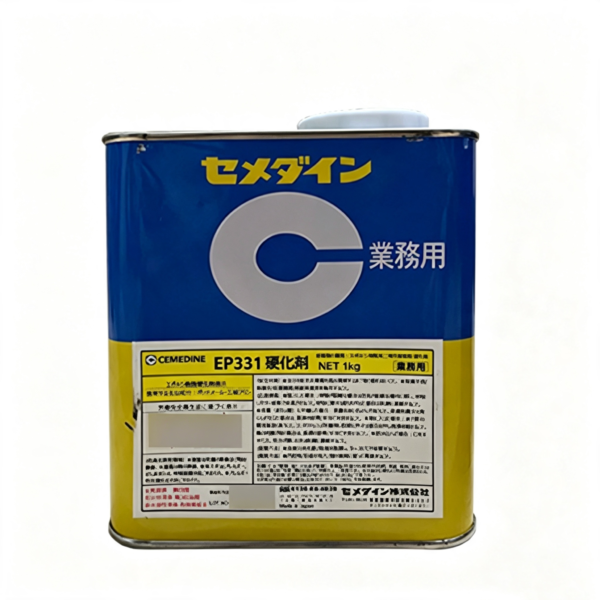

EP331 uses an epoxy-resin base and a polythiol hardener. Both components have a light-yellow transparent appearance, helping the mixed adhesive produce a relatively unobtrusive bond line. CEMEDINE lists a viscosity of approximately 4 Pa·s for the resin and 5 Pa·s for the hardener at 23°C. This low-viscosity profile supports easy spreading, controlled flow, penetration into small surface irregularities, and coverage of broad bonding areas.
The manufacturer specifies a 1:1 mixing ratio. At 23°C, the usable time is within approximately 30 minutes, while practical strength can develop after about one hour. The standard full-curing condition is approximately 24 hours at 23°C. Actual working and curing times depend on the amount mixed, ambient temperature, substrate temperature, joint thickness, and heat generated by the epoxy reaction.
CEMEDINE recommends this epoxy family for bonding and sealing electrical and electronic components, joining building composite materials, and assembling precision instruments and craft products. EP331 is particularly valuable where a lower-viscosity adhesive is required to wet the bonding area, flow around components, or enter narrow spaces that a non-sag paste cannot easily reach.
Typical evaluated applications may include electronic module assembly, terminal sealing, sensor-component bonding, coil and transformer reinforcement, instrument parts, rigid composite structures, decorative components, precision mechanical assemblies, and small industrial products. The adhesive may also be considered for compatible metals, ceramics, glass, rigid plastics, and composite materials after adhesion and environmental testing with the actual production substrates.
Because EP331 flows more readily than high-viscosity epoxy pastes, fixtures, dams, masking, or controlled dispensing equipment may be required to prevent migration into connectors, switches, optical areas, threads, or other locations that must remain free from adhesive. The low viscosity also makes accurate control of the applied volume important during automated assembly.
The resin has a published density of approximately 1.19 g/cm³, while the hardener has a density of approximately 1.20 g/cm³. After standard curing, the adhesive provides tensile-shear strength of about 17.6 MPa and T-peel strength of approximately 0.24 N/mm under CEMEDINE test conditions.
Typical cured properties include Shore D hardness of approximately 82, a glass-transition temperature near 41°C, water absorption of about 0.8%, and a coefficient of linear expansion of approximately 7.1 × 10⁻⁵/K. The published volume resistivity is approximately 1.1 × 10¹⁶ Ω·cm, supporting its use as an insulating adhesive in properly designed electrical applications.
These values are reference laboratory results rather than guaranteed finished-assembly specifications. Actual performance depends on substrate preparation, adhesive thickness, mixing accuracy, curing temperature, joint design, loading direction, humidity, chemicals, and operating conditions.
Remove oil, grease, dust, rust, moisture, release agents, old adhesive, and loose contamination from both surfaces. Smooth metals and rigid materials may benefit from light abrasion followed by another cleaning step. The prepared surfaces must be completely dry before the adhesive is applied.
Measure equal quantities of resin and hardener according to the specified 1:1 ratio. Mix thoroughly until the material is uniform, scraping the sides and bottom of the mixing container to prevent unmixed components from entering the joint. Avoid introducing excessive air, particularly when the adhesive will be used around electronic components or visible surfaces.
Apply the mixture within the available 30-minute working time. Join the parts and maintain alignment with suitable fixtures while practical strength develops. Because the adhesive is low viscosity, use controlled dispensing, masking, temporary barriers, or suitable joint geometry to prevent uncontrolled flow.
Allow approximately 24 hours at 23°C for the standard cure before demanding mechanical loading or environmental exposure. Lower temperatures generally slow curing, while warmer conditions and larger mixed quantities can shorten the working time. Production qualification should verify adhesion, insulation, thermal cycling, humidity resistance, chemical exposure, flow control, and long-term reliability.
CEMEDINE lists EP331 in separate 1 kg cans for the resin and hardener. Keep both containers tightly closed, prevent cross-contamination between the components, and never return mixed material to the original packages. Store and handle the product according to the current label and safety data sheets.
Review the official CEMEDINE EP331 technical information and the official CEMEDINE two-component epoxy adhesive guide for current specifications, application information, packaging, and safety-document access.
Explore our low-viscosity epoxy adhesives for additional flowing and precision-dispensing products. Browse our electronic assembly epoxy adhesives for bonding, sealing, insulation, reinforcement, and component protection applications.