Address
304 North Cardinal
St. Dorchester Center, MA 02124
Work Hours
Monday to Friday: 7AM - 7PM
Weekend: 10AM - 5PM
Address
304 North Cardinal
St. Dorchester Center, MA 02124
Work Hours
Monday to Friday: 7AM - 7PM
Weekend: 10AM - 5PM
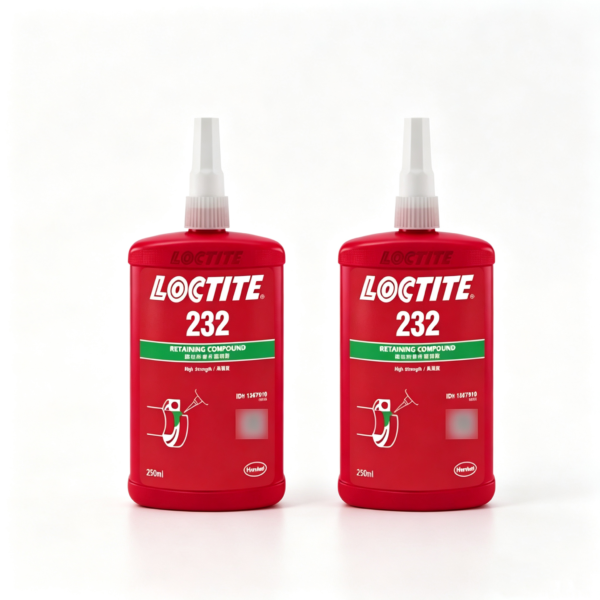
LOCTITE 232 Retaining Compound is designed for applications where assembly forces are high and operators need controlled lubrication together with dependable retention. The adhesive fills microscopic spaces between fitted metal surfaces, helping distribute loads across the joint and reduce local movement. This can improve the reliability of cylindrical assemblies and threaded connections exposed to vibration, heavy torque, or repeated equipment operation.
Its one-part format eliminates resin-to-hardener measurement and simplifies production preparation. The medium viscosity provides controlled application around shafts, collars, bushings, plugs, and threaded sections without flowing as quickly as low-viscosity grades. Henkel also describes the product as slow curing, which can provide additional assembly time for large, complex, or tightly fitted components.
Typical applications include heavy interference fits, press-fitted shafts and collars, sleeves, bushings, expansion plugs, and cylindrical components in industrial machinery. It is also suitable for highly torqued threaded assemblies where lubrication during tightening and medium-strength retention after curing are required. Common industries may include heavy equipment, motors, pumps, gear systems, metal processing, transportation equipment, and maintenance operations.
The product is intended primarily for close-fitting metal surfaces. It is not normally recommended for thermoplastics because stress cracking may occur. Users should also confirm compatibility when aqueous washing systems, special coatings, unusual metals, or production residues are present, as these conditions can influence anaerobic curing and final performance.
The uncured material is an opaque brown methacrylate ester liquid with a typical specific gravity of 1.02 at 25°C. Henkel publishes a Brookfield viscosity range of 3,600 to 8,800 mPa·s at 25°C, confirming its medium-viscosity processing profile. After curing for two hours at 121°C, typical compressive shear strength on steel pins and collars is at least 7.0 N/mm² under the specified test method.
These figures are typical technical values rather than guaranteed purchasing specifications. Actual performance depends on metal activity, surface cleanliness, joint clearance, adhesive quantity, assembly method, curing temperature, and service conditions. Inactive metals or slow-curing applications may require LOCTITE SF 7471 or LOCTITE SF 7649 Activator after production testing.
Clean internal and external bonding surfaces with a compatible LOCTITE cleaning solvent and allow them to dry. For slip-fitted assemblies, apply adhesive around the leading edge of the shaft and inside the collar, then rotate the parts during assembly to improve coverage. For press fits, coat both bonding surfaces thoroughly before pressing the components together. For shrink fits, apply adhesive to the shaft and heat the collar to create sufficient clearance for assembly.
Do not disturb the parts until adequate handling strength develops. Henkel recommends allowing at least three days of curing before testing disassembly forces. When dismantling is required, localized heat of approximately 250°C may be applied before separating the assembly while hot. Review the current Safety Data Sheet before handling, storage, or production use.
LOCTITE 232 Retaining Compound combines medium-strength retention, assembly lubrication, corrosion protection, anti-galling performance, and controlled viscosity in a convenient one-component system. It is a practical commercial choice for manufacturers and maintenance teams working with heavy press fits and high-torque metal assemblies.
Review the official Henkel LOCTITE 232 Technical Data Sheet before qualification. Explore our industrial retaining compounds for additional bearing, shaft, sleeve, bushing, and cylindrical assembly solutions.