Address
304 North Cardinal
St. Dorchester Center, MA 02124
Work Hours
Monday to Friday: 7AM - 7PM
Weekend: 10AM - 5PM
Address
304 North Cardinal
St. Dorchester Center, MA 02124
Work Hours
Monday to Friday: 7AM - 7PM
Weekend: 10AM - 5PM
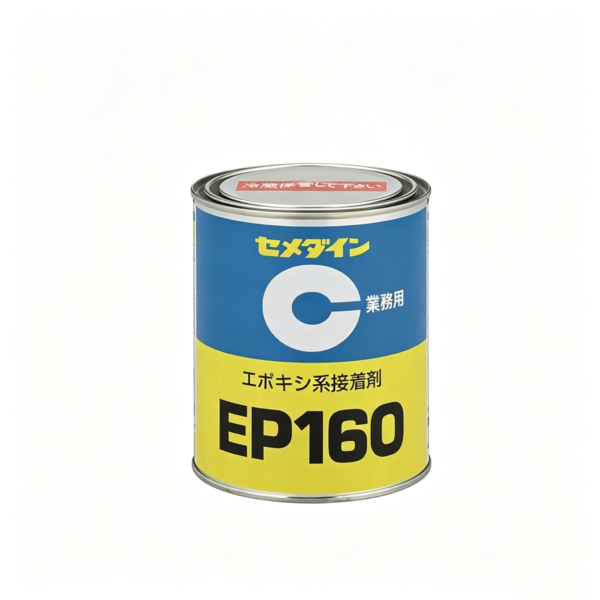
CEMEDINE EP160 Heat-Curing Epoxy Adhesive is a one-component, solvent-free epoxy designed for bonding and sealing applications that require reliable adhesion, electrical insulation, and resistance to elevated temperatures. Because the product is supplied as a ready-to-use single component, manufacturers do not need to weigh or mix resin and hardener. This helps eliminate ratio errors, improves process consistency, and simplifies manual or automated dispensing in high-volume production.
The light-yellow transparent paste remains stable during controlled application and cures after exposure to the specified heating cycle. CEMEDINE positions EP160 as a heat-resistant, medium-viscosity adhesive suitable for electrical parts, electronic components, automotive components, precision equipment, and compatible composite assemblies. Its reactive epoxy chemistry produces no solvent-evaporation stage and forms a hard, durable bond after curing.
CEMEDINE EP160 Heat-Curing Epoxy Adhesive combines convenient one-part processing with strong mechanical and thermal performance. Current Japanese product information lists a typical viscosity of approximately 76 Pa·s at 23°C and a density of about 1.02 g/cm³. This medium-viscosity consistency supports controlled bead, dot, and coating application without behaving like an excessively thin liquid.
Standard published curing schedules include approximately 30 minutes at 120°C or 15 minutes at 150°C. The shorter high-temperature cycle can support faster production when the bonded components tolerate the required heat. After curing, the material has a typical Shore D hardness of 85 and a glass-transition temperature of approximately 140°C, supporting assemblies exposed to elevated temperatures and repeated thermal changes.
CEMEDINE’s global technical table lists representative tensile-shear strength of approximately 16.8 MPa and T-peel strength of about 1.18 N/mm. Additional published properties include low water absorption, high volume resistivity, and useful dielectric characteristics. These properties make the adhesive suitable for applications where structural retention and electrical insulation must be provided by the same cured material.
CEMEDINE EP160 Heat-Curing Epoxy Adhesive is suitable for bonding and sealing electrical and electronic components, automotive electrical parts, sensors, metal housings, terminals, coils, ceramic elements, and compatible precision assemblies. It may also be evaluated for bonding architectural composite materials, industrial instruments, and crafted products requiring a hard, heat-resistant epoxy bond.
The product is especially useful in controlled factory processes where an oven or localized heating system is already available. Because heat is required for curing, every component in the assembly must tolerate the selected temperature cycle without deformation, discoloration, loss of coating adhesion, or damage to sensitive electronics.
Actual performance depends on the substrate, coating, surface condition, bond-line thickness, heating method, temperature uniformity, fixture design, and service environment. Representative production parts should be tested before mass use, particularly for safety-critical, automotive, high-voltage, or continuously heated applications.
Before applying the adhesive, remove oil, grease, dust, moisture, oxide, release agents, and other contamination from each bonding surface. Abrasion or another compatible pretreatment may improve adhesion on selected metals, but the complete cleaning method should be verified on the actual component.
Dispense a controlled amount onto the prepared surface, assemble the parts, and secure them with a suitable fixture. Place the assembly in calibrated heating equipment and cure it using a validated temperature-and-time schedule. Cure timing should begin only after the adhesive layer reaches the required temperature.
Avoid moving or loading the assembly before adequate curing has occurred. For repeatable manufacturing, standardize dispensing volume, bond-line thickness, assembly time, fixture pressure, oven temperature, heating time, cooling conditions, and final inspection.
Store CEMEDINE EP160 Heat-Curing Epoxy Adhesive in its unopened original container under the temperature conditions stated on the current label and technical documentation. Prevent contamination and do not return dispensed adhesive to the original package. Review the latest SDS before handling and use appropriate ventilation, gloves, eye protection, and workplace controls.
For manufacturers seeking a one-component epoxy for heat-resistant electronic and industrial assembly, EP160 provides no-mix processing, strong adhesion, electrical insulation, low water absorption, and a high glass-transition temperature. Explore our heat-curing epoxy adhesives for additional electronics, automotive, sensor, and precision-component bonding solutions.