Address
304 North Cardinal
St. Dorchester Center, MA 02124
Work Hours
Monday to Friday: 7AM - 7PM
Weekend: 10AM - 5PM
Address
304 North Cardinal
St. Dorchester Center, MA 02124
Work Hours
Monday to Friday: 7AM - 7PM
Weekend: 10AM - 5PM
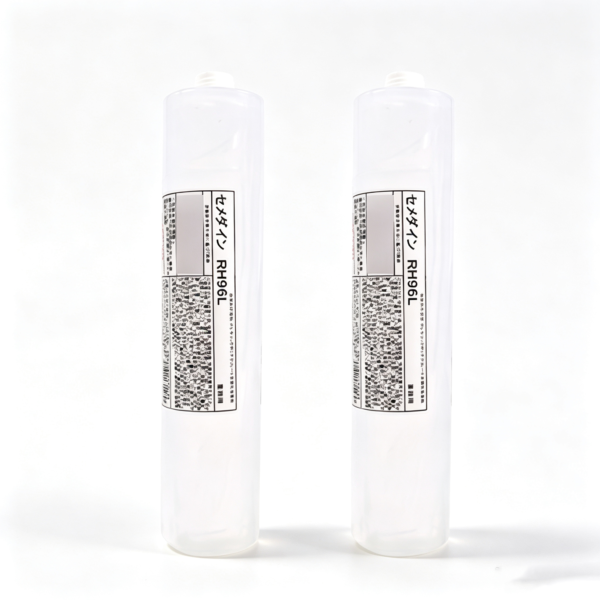
CEMEDINE RH96L Thermally Conductive Elastic Adhesive transfers heat while maintaining an elastic bond between the heat-generating component and the heat-dissipation surface. This flexibility helps accommodate vibration, impact and differences in thermal expansion between substrates. The cured material remains attached to vertical surfaces and moving assemblies, supporting consistent thermal contact in demanding electronic equipment.
Unlike non-curing thermal grease, RH96L cures or semi-cures after application. This helps prevent pump-out during repeated heating, cooling and vibration. CEMEDINE also states that the cured material shows no compound bleeding or shrinkage, allowing it to function as a curable thermal grease where permanent contact and cleaner assembly are required.
The formulation contains no low-molecular-weight silicones, reducing concern about electrical contact failures associated with silicone contamination. Strong adhesion may also help reduce screws or mechanical retainers in properly qualified designs. Its one-component format requires no resin-to-hardener measurement, simplifying manual and automated dispensing.
RH96L is intended for thermal management around semiconductor devices, CPU assemblies, DC motor control chips and other heat-generating electronic components. It can be applied between a device and a heat sink, metal housing or thermal spreader where both heat transfer and flexible fixation are required.
Typical applications may include inverters, DC-DC converters, DC-AC converters, motor-control units, power modules, industrial controls, automotive electronics, communication equipment and appliances. Its resistance to vibration and ability to remain on vertical surfaces make it useful for modules that cannot rely on free-flowing thermal grease.
Every application should be qualified using the actual substrates, bond-line thickness, operating temperature, thermal cycle, electrical requirements and dispensing process. Adhesion and thermal performance can change with surface finish, contamination, component geometry and environmental conditions.
The uncured product is a gray paste based on a special acrylic-modified polymer. CEMEDINE lists a viscosity of approximately 250 Pa·s at 23°C, an SVI of 4.5 and a density of approximately 2.15 g/cm³. Typical skin-over time is about seven minutes at 23°C, supporting fast processing while allowing controlled component placement.
Representative cured properties include Shore A hardness of approximately 65, glass-transition temperature of about -44°C, breaking strength of 1.1 MPa and elongation at break of approximately 45%. Thermal conductivity is listed at 2.14 W/m·K, while volume resistivity is approximately 4.1 × 10¹¹ Ω·cm and insulation breakdown strength is about 22 kV/mm.
CEMEDINE reports continued adhesion during heat-aging tests at 150°C and thermal-shock testing from -40°C to 125°C. These results support use in electronics exposed to repeated temperature changes, although published values are typical technical data rather than guaranteed purchasing specifications.
Clean the bonding and thermal-contact surfaces and remove oil, dust, moisture, oxidation and processing residue. Dispense a uniform bead or controlled layer onto the component, heat sink or housing. Assemble the parts within the validated working window and maintain the specified bond-line thickness so the adhesive can provide thermal transfer and mechanical support.
Avoid excessive application because a thick layer may increase thermal resistance and extend curing time. Confirm dispensing pressure, nozzle size, bead geometry, assembly time and curing conditions through production trials. Protect opened packaging from moisture and contamination and follow the latest CEMEDINE technical and safety documentation.
CEMEDINE RH96L Thermally Conductive Elastic Adhesive combines 150°C heat resistance, 2.14 W/m·K thermal conductivity, elastic bonding, electrical insulation and pump-out prevention in a convenient one-component system. It is a practical Japanese material for semiconductor heat management, motor controls, power electronics and vibration-sensitive thermal assemblies.
Review the official CEMEDINE SX-TCA Series product information before qualification. Explore our thermally conductive adhesives for additional electronic heat-dissipation and component-bonding solutions.